Investment Management
Investment Management Process
Our four-step investment process begins with understanding your needs, your goals and your risk tolerance.
We then design a portfolio just for you.
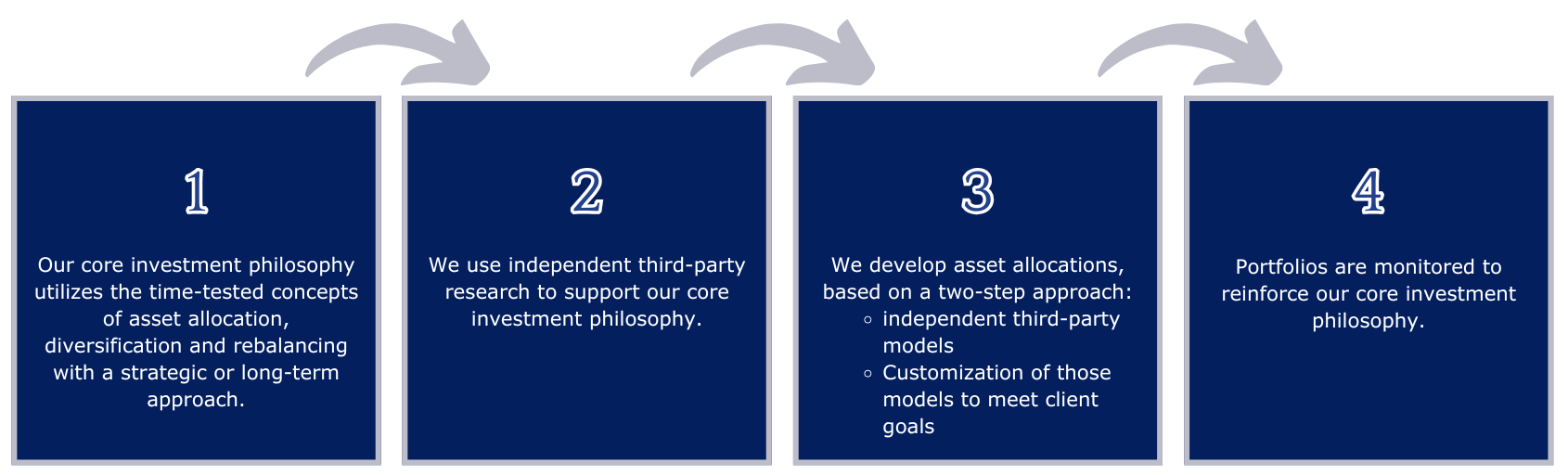
Within our portfolios, we utilize low-cost index funds and exchange-traded funds (ETFs.) According to Morningstar, costs can be one of the best predictors of future results.
Our diversified portfolios of 15 different asset classes work well together and are positively supported by peer-reviewed, academic research.
As a fiduciary, our job is to make investment decisions that are in your best interest. This means ignoring the daily headlines and sticking with evidence-based solutions.
All investing involves risk including loss of principal. No strategy assures success or protects against loss. There is no guarantee that a diversified portfolio will enhance overall returns or outperform a non-diversified portfolio. Diversification does not protect against market risk. Asset allocation does not ensure a profit or protect against a loss. Rebalancing a portfolio may cause investors to incur tax liabilities and/or transaction costs and does not assure a profit or protect against a loss.
Your Changing Definition of Risk in Retirement
Emotional vs. Strategic Decisions
Eight Mistakes That Can Upend Your Retirement
What is fiduciary investment management?
It means your advisor is required to put your interests first. In plain terms, your investment decisions are built around your goals, your timeline, and your comfort with risk.
How can you help me manage my investments?
We start by understanding what is most important to you — retirement, income, lifestyle, legacy, or all of the above. Then we build and manage a portfolio designed to support that plan, and we adjust it as life changes.
What makes your investment approach different?
We use a plan-first, research-based approach. Our main focus is on building a well-structured portfolio and sticking to a disciplined strategy through different market cycles. We are fee-based and have no proprietary products to sell. This always allows us to use the investments that are in our clients’ best interest.
Do you use low-cost funds?
Yes. Many portfolios use low-cost ETFs and index funds. Keeping investment costs low is one of the simplest ways to improve long-term results without taking on extra risk.
How do you manage risk?
We balance growth and protection by building diversified portfolios and matching the strategy to your personal risk tolerance and time horizon. The goal is to help you stay invested with confidence, even when markets get uncomfortable.
Can you rebalance my portfolio?
Yes. Rebalancing helps keep your investment mix aligned with your plan over time. It’s a disciplined way to avoid drifting into more risk than you intended after strong market runs.
Is investment management only for those entering retirement?
Investment management is designed to support your broader financial plan, and many clients are focused on retirement. But the strategy can also support other priorities like tax efficiency, major life transitions, or long-term wealth planning.
Who is a good fit for investment management services?
Investment management is a strong fit for people who want a long-term relationship with a fiduciary advisor and prefer a thoughtful, structured approach over DIY guesswork. It’s especially helpful if you want your investments coordinated with retirement and tax planning.